Posts

Showing posts with the label Apache

Signing SOAP Messages - Generation of Enveloped XML Signatures
Image
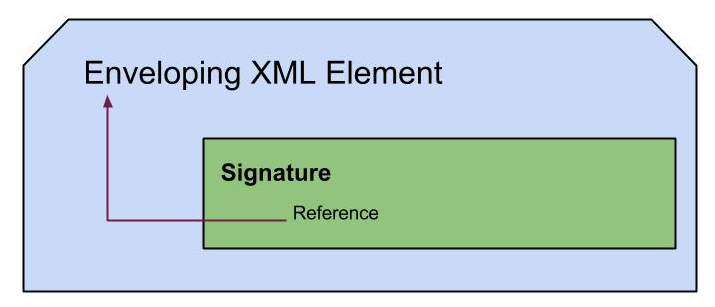
Digital signing is a widely used mechanism to make digital contents authentic. By producing a digital signature for some content, we can let another party capable of validating that content. It can provide a guarantee that, is not altered after we signed it, with this validation. With this sample I am to share how to generate the a signature for SOAP envelope. But of course this is valid for any other content signing as well. Here, I will sign The SOAP envelope itself An attachment  Place the signature inside SOAP header  With the placement of signature inside the SOAP header which is also signed by the signature, this becomes a demonstration of enveloped signature. I am using Apache Santuario library for signing. Following is the code segment I used. I have shared the complete sample here to to be downloaded . public static void main(String unused[]) throws Exception {         String keystoreType = "JKS";         Stri...

Hadoop Multi Node Set Up

   With this post I am hoping to share the procedure to set up Apache Hadoop in multi node and is a continuation of the post,  Hadoop Single Node Set-up . The given steps are to set up a two node cluster which can be then expanded to more nodes according to the volume of data. The unique capabilities of Hadoop can be well observed when performing on a BIG volume of data in a multi node cluster of commodity hardware.    It will be useful to have a general idea on the  HDFS(Hadoop Distributed File System) architecture which is the default data storage for Hadoop, before proceed to the set up, that we can well understand the steps we are following and what is happening at execution. In brief, it is a master-slave architecture where master act as the NameNode which manages file system namespace and slaves act as the DataNodes which manage the storage of each node. Also there are JobTrackers which are master nodes and TaskTrackers which are ...

Hadoop Single Node Set Up

Image
With this post I am hoping to share the procedure to set up Apache Hadoop in single node. Hadoop is used in dealing with Big Data sets where deployment is happening on low-cost commodity hardware. It is a map-reduce framework which map segments of a job among the nodes in a cluster for execution. Though we will not see the exact power of Hadoop running it on single node, it is the first step towards the multi-node cluster. Single node set up is useful in getting familiar with the operations and debugging applications for accuracy, but the performance may be far low than what is achievable. I am sharing the steps to be followed on a Linux system, as it is supported as both a development and a  production platform for Hadoop. Win32 is supported only as a development platform and equivalent commands for the given Linux commands need to be followed. This  Hadoop document  includes the details for setting up Hadoop, in brief. I am here sharing a detailed guidance f...

Apache Wookie W3C Widget Digital Signature Implementation - GSoC2012

Image
I am here sharing my GSoC 2012 project details which I enjoyed a lot while learning. This includes a brief introduction on the project with it's design, implementation and guidance on using. The implementation has been done using Apache Santuario 1.5.2 release to generate digital signatures. The project is mentored by Scott Wilson who was so helpful and supported by the community. This is Scott Wilson's post on the project. What is Apache Wookie? Apache Wookie is a Java server application that allows widget uploading and deployment as useful for variety of applications. This may include gadgets to quizzes and games. Wookie has been based on W3C widget specification while providing flexibility on Google Wave gadgets etc. At the moment of writing, it is in the Apache incubator getting ready to graduate as an Apache Project.  Objective of the project The objective this project is to implement the ' W3C XML Digital Signatures for Widgets ' specification i...

Bulk-Loading Data to Cassandra with sstable or JMX

Image
The 'sstableloader' introduced from Apache Cassandra 0.8.1 onwards, provides a powerful way to load huge volumes of data into a Cassandra cluster. If you are moving from a cloud cluster to a dedicated cluster or vice-versa or  from a different database to Cassandra you will be interested in this tool. As shown below in whatever case if you can generate the 'sstable' from the data to be loaded into Cassandra, you can load it in bulk to the cluster using 'sstableloader'. I have tried it in version 1.1.2 here. With this post I ll share my experience where I created sstables from a .csv file and loaded to a Cassandra instance running on same machine, which acts as the cluster here. sstable generation Bulk loading Cassandra using sstableloader Using JMX 'sstable' generation To generate 'SSTableSimpleUnsortedWriter' the 'cassandra.yaml' file should be present in the class path. In Intellij Idea you can d...

Running Cassandra in a Multi-node Cluster

Image
This post gathers the steps I followed in setting up an Apache Cassandra cluster in multi-node. I have referred Cassandra wiki and Datastax documentation in setting up my cluster. The following procedure is expressed in details, sharing my experience in setting up the cluster. Setting up first node Adding other nodes Monitoring the cluster - nodetool , jConsole , Cassandra GUI I used Cassandra 1.1.0 and Cassandra GUI - cassandra-gui-0.8.0-beta1 version(As older release had problems in showing data) in Ubuntu OS. Setting up first node Open cassandra.yaml which is in 'apache-cassandra-1.1.0/conf'. Change listen_address: localhost -->  listen_address: <node IP address>          rpc_address: localhost -->  rpc_address: <node IP address> - seeds: "127.0.0.1" --> - seeds: "node IP address" The listen address defines where the other nodes in the cluster should connect. So in a multi-node cluster it should to...